
Why "Mistakes Are Just Data" Sounds Hollow
The Hidden Luxury of the Growth Mindset
LEADERSHIP WITHIN SYSTEMS
7/15/20265 min read
We see it all over professional development spaces, leadership keynotes, and corporate training manuals:
"Fail fast, fail often."
"Embrace the 'not yet' mindset."
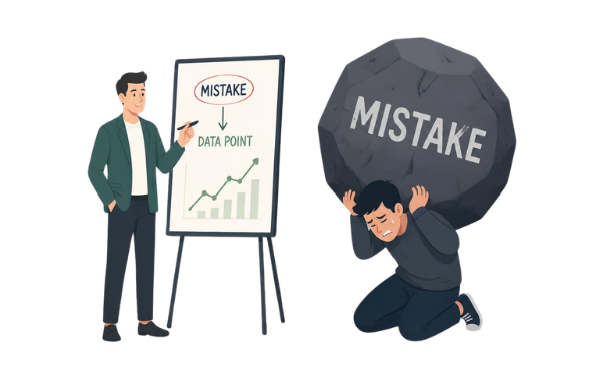
"Be kinder to yourself; mistakes are just data points."
While these frameworks are well-intentioned, they often feel deeply alienating to a large portion of the workforce.
When we apply universal mindset advice without taking into account systemic inequalities, organizational pay gaps, and an individual’s true socioeconomic reality, it doesn't help.
It gaslights.
By treating structural risks as personal mindset flaws, mainstream professional development inadvertently turns a logical survival mechanism into an attitude problem.
Having been in hundreds of coaching conversations, I noticed a is simple truth that has become hard to ignore: Truly changing your mindset is impossible without first understanding your safety net.
What the Reasearch Says: The Socioeconomic Self
Social psychology and behavioural science prove that macro-level societal status directly dictates and individual's self-perception.
The Erosion of Self-Respect: A long-term study published by the American Psychological Association discovered that chronic exposure to lower-income environments specifically targets an individual's self-respect— the belief that they possess the same fundamental human rights and dignity as others. Privileged environments buffer this, leaving self-worth intact even during failure. [1]
The "Undervalued Self": Research featured in Frontiers in Psychology shows that reminders of subordinate status elicit immediate negative self-conscious emotions like shame and anxiety. A lower socioeconomic status (SES) environment chronically trains the brain to undervalue its own capabilities. [2]
Internalized Negative Feedback: Global studies on socioeconomic meta-perceptions indicate that lower-SES individuals hold more negative expectations of how others view them. Because of this baseline, they are significantly more likely to blame their own core competence or personality when a professional interaction or piece of feedback goes poorly. [3]
Why Mainstream Advice Falls Flat
To understand why generalised growth mindset narratives ring so hollow in light of this data, we have to look at the material reality of risk to the individual.
1. The Luxury of the "Data Point"
Viewing a failure as an intellectual "data point" requires cushioning. For a privileged professional, a career mistake or a failed venture is an expense; they lose capital or time, but their baseline security remains completely untouched.
For someone from a lower socioeconomic background, a mistake is not an intellectual data point — it is an existential threat. When a single misstep can trigger a domino effect of immediate financial instability, debt, or job loss, avoiding mistakes entirely is a highly rational defense mechanism, not a lack of ambition.
2. "Self-Kindness" Feels Like Danger
When your livelihood has historically depended on being hyper-vigilant, harsh self-criticism acts as a psychological armor. It is the voice that tells you to check your work five times because you cannot afford a slip-up.
Telling someone to "just stop being so hard on yourself" ignores how deeply wired that defense mechanism is. To the nervous system of someone who has survived financial precarity, letting your guard down feels like inviting disaster.
Universal Steps to Take (Regardless of Your Situation)
If you want to move past hollow advice and build a sustainable relationship with failure, you have to anchor your brain in raw data, not vague platitudes.
Step 1: Take Stock of Your True Situation
Strip away the emotion and look at the raw facts. Audit your actual financial runway, contract stability, resources you have (including social network) and tangible safety nets. If a mistake happens today, what is the literal, mathematical consequence? Knowing your exact baseline removes the foggy, paralyzing panic of the unknown.
Step 2: Classify the Threat Level
When panic strikes, pause and ask: "Is my past habit speaking, or is my current livelihood truly at stake right now?"
If it is a real threat, stop worrying about your mindset and focus entirely on external strategy, resource allocation, and community support.
If it is a perceived threat, focus on internal regulation, reminding your body that you are uncomfortable, but you are safe.
Step 3: Micro-Dose Low-Stakes Risks
If you are financially secure but your brain refuses to believe it, you have to retrain your nervous system through lived experience. Intentionally make minor, low-stakes mistakes (eg: leave a non-urgent email unanswered for an hour, or say "I don't know, let me look into that" in a meeting instead of over-preparing.)
Prove to your body that the world does not collapse when you step off the treadmill of perfectionism.
Step 4: Normalise indicators of competency
Accept compliments cleanly and force yourself to say "thank you" and let the data point sit in your brain without arguing against it. Look at your mistakes without emotional weight - like how a scientist treats a failed lab experiment - an objective piece of information that tells you what you tweak next, rather than a verdict of yourself.
How Coaches, Leaders and Organizations Can Adapt
If we want to build genuinely inclusive workplaces and coaching spaces, we cannot use a "one-size-fits-all" framework. Leaders, HR professionals, and coaches must adapt their approach to reflect the reality of systemic disparities and pay gaps.
1. Shift from "Abundance" to "Resource Optimization"
Mainstream coaching often pushes an "abundance mindset"— the belief that resources are limitless if you simply change your frequency. For lower-income individuals, resources are objectively finite. Equity-informed coaching must shift the focus to Resource Optimization: the strategic allocation of real assets, energy management, and identifying high-leverage actions that require zero financial capital.
2. Introduce the "Staged Risk" Model
The standard coaching prompt, "What would you do if you knew you couldn't fail?" assumes failure carries similar weight for everyone, and therefore imagining failure without material cost is easy. Instead, coaches should use a Staged Risk model for clients without a luxury safety net. Prioritize establishing baseline stability, co-create rigorous fallback options, and secure an absolute safety threshold before introducing secondary, high-risk growth goals.
3. Take care of hygiene factors first
Leading teams in different geographies requires a baseline of material fairness. If your team perceives that certain regions are structurally exploited while others are cushioned, psychological safety will collapse. Go beyond basic currency conversions. Work with HR to ensure benefits are locally optimized—pivoting standard stipends toward local priorities like transportation allowances, localized mental health care, or childcare infrastructure.
4. Decode regional power distance and risk tolerances
Socioeconomic history and geography heavily influence a team member's comfort level with pushing back against authority. Workers from affluent Western backgrounds are often comfortable voicing disagreement openly. Conversely, workers from regions with hierarchical business cultures or histories of economic precarity often view overt pushback as an active threat to their job security.
To bypass this, replace open-ended verbal questions with anonymous feedback loops, structured digital polling tools, or asynchronous written reviews. This allows team members to voice critical risks without fearing professional exposure.
5. Separate performance from resource constraints
Leaders often misinterpret a lack of real-time digital response as a lack of engagement or poor performance, failing to account for geographic infrastructure disparities. Acknowledge that team members in volatile regions or developing economies face objective hurdles like power grid failures or unstable internet routing. Focus strictly on outcomes and milestones rather than demanding rigid, instantaneous digital presence, and provide connectivity stipends where necessary to bridge the structural gap.
The Bottom Line
Real growth doesn't come from pretending risks don't exist or ignoring systemic hurdles. It comes from looking your actual reality in the eye, validating the survival mechanisms that got you to where you are today, and pacing your growth accordingly.
References:
D. Renger, J. F. Lohmann, S. Renger, and S. E. Martiny, “Socioeconomic Status and Self-Regard: Income Predicts Self-Respect Over Time,” Social Psychology, vol. 55, no. 1, pp. 12–24, Jan. 2024, doi: 10.1027/1864-9335/a000536.
Kraus MW, Park JW. The undervalued self: social class and self-evaluation. Front Psychol. 2014 Dec 5;5:1404. doi: 10.3389/fpsyg.2014.01404. PMID: 25538654; PMCID: PMC4256993.
Engstrom HR, Laurin K, Kay NR, Human LJ. Socioeconomic Status and Meta-Perceptions: How Markers of Culture and Rank Predict Beliefs About How Others See Us. Pers Soc Psychol Bull. 2024 Sep;50(9):1386-1407. doi: 10.1177/01461672231171435. Epub 2023 May 22. PMID: 37212389; PMCID: PMC11318217.